What is a Theory of Change? A Practical Guide for NGOs

A theory of change explains how your day-to-day work leads to the change you exist to create. This guide covers what it is, how it differs from a logical framework and a results framework, the results chain model that underpins it, and why the same logic now drives goal-setting in the tech sector, where it goes by the name OKRs.
Key Takeaways
- A theory of change is the causal logic that connects your activities to your mission: if we do this, then that changes, because of these assumptions.
- Theory of change, logical framework, and results framework are related but not interchangeable. The theory of change is the narrative; the others are the tables you derive from it.
- The results chain (inputs → activities → outputs → outcomes → impact) is the skeleton that all three share.
- This isn't just an NGO tool. OKRs, the goal-setting method Google and much of the tech world swear by, are really a theory of change in disguise: an aspirational goal tied to a few measurable results.
- The most common failures are being too complex, not testable, or disconnected from M&E.
A theory of change is your explanation of how the work you do each day connects to the change your organization exists to create. Put plainly: if we run these activities, then we expect these results, because we believe change happens a certain way.
Most people first encounter a theory of change because a donor asked for one or a proposal template had a blank section to fill. But it is far more useful than that. Done well, it aligns your team around a shared goal, sharpens which indicators actually matter, and gives you a testable claim you can learn from. At Hikaya, we help organizations build theories of change that do this work, then connect them to M&E systems people actually use.
What is a Theory of Change?
A theory of change is a description, usually visual, of how and why a desired change is expected to happen in a particular context. It maps the pathway from what you invest to the long-term impact you are aiming for, and names the assumptions holding that pathway together.
You need one whenever you have to explain your logic to someone else, or to yourself: designing a new program, responding to a donor, aligning a team that has drifted, or evaluating whether a project worked. Major funders expect it: Global Affairs Canada, the UK's FCDO, and the EU's humanitarian office ECHO all ask organizations to show the reasoning behind their results, not just a list of activities.
A theory of change answers four questions:
- What long-term change are we trying to create?
- What has to happen along the way for that change to hold?
- What will we do to set those changes in motion?
- What are we assuming about how this all connects?
Key insight
A theory of change is not a plan of what you will do. It is an argument for why doing it will matter. The activities are the easy part; the assumptions between them are where the real thinking lives.
Theory of Change vs Logical Framework vs Results Framework
These terms get used interchangeably, but they describe the same underlying logic at different levels of detail. The theory of change is the story; the others are structured views you extract from it.
| Tool | What it is | Best for | Form |
|---|---|---|---|
| Theory of change | The full narrative of how and why change happens, including assumptions | Design, alignment, communicating your logic | Diagram + narrative |
| Results framework | The hierarchy of results (also called a results chain), stripped to the pathway | Showing how objectives ladder up | Pathway diagram |
| Logical framework (logframe) | A grid of objectives, indicators, means of verification, and assumptions | Donor reporting, M&E planning | 4×4 table |
| OKRs | Objectives paired with measurable key results | Aligning teams to goals, quarterly focus | Objective + 3–5 results |
The practical takeaway: start with the theory of change, because everything else is a projection of it. Your logframe indicators should trace directly back to the outcomes in your pathway. When they do not, that gap is usually where a program loses the thread. For a deeper comparison of when to reach for each, our monitoring and evaluation framework guide walks through how these pieces fit into a working system.
The Results Chain: From Inputs to Impact
Underneath all of these tools sits one model: the results chain. It is the sequence of cause and effect that turns resources into lasting change, used across the sector by bilateral donors and implementing organizations alike.
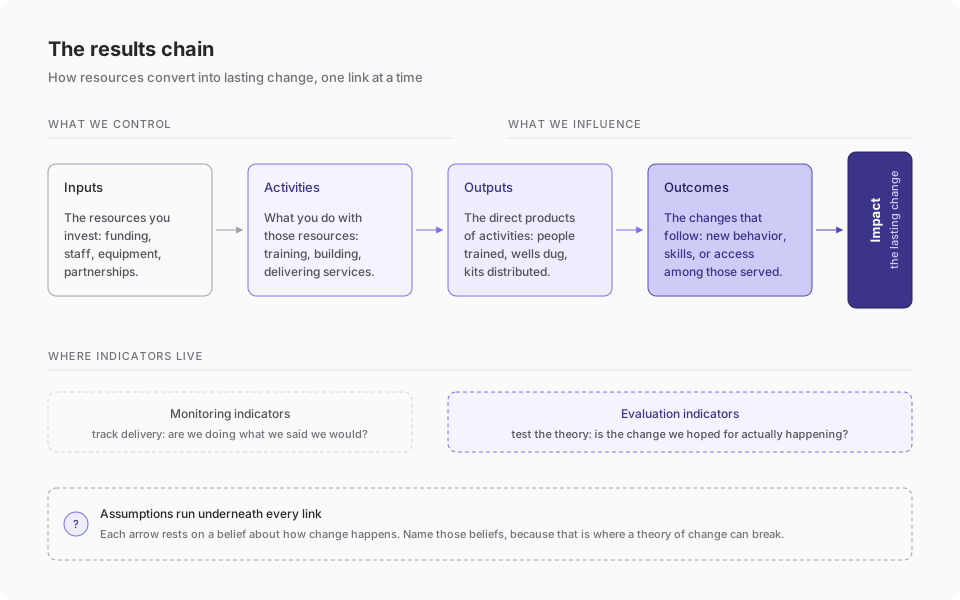
Read left to right, each stage feeds the next:
- Inputs are what you invest: funding, staff, equipment, partnerships.
- Activities are what you do with them: training, building, delivering services.
- Outputs are the direct products of those activities: people trained, wells dug, kits distributed.
- Outcomes are the changes that follow: new behavior, skills, or access among the people you serve.
- Impact is the lasting change your mission points to.
The line between outputs and outcomes matters most. Outputs are what you control. Outcomes are what you influence. A program can hit every output target and still fail to produce the outcome.
Watch out
Counting outputs is not measuring change. "We trained 500 people" is an output. "70% of those trained changed a practice six months later" is an outcome. If your indicators stop at outputs, you are tracking effort, not results.
This is also where indicators find their home. Monitoring indicators track the early links (are we delivering what we said?), while evaluation indicators test the later ones (is the change actually happening?). Resources like IndiKit and the IRC's Outcomes and Evidence Framework organize indicators by this logic, which makes them useful starting points when deciding what to measure at each stage.
Tech Companies Use a Theory of Change Too. They Call It OKRs
The private sector uses the same structure. They call it OKRs: objectives and key results. Google and a wave of tech startups adopted OKRs to connect team effort to company-wide goals, and KPIs made metrics mainstream in business more broadly.
An OKR pairs an aspirational objective (where we want to go) with a handful of measurable key results (how we will know we are getting there). The objective is the impact; the key results are the outcomes that prove you are getting there. Program teams in the field and product teams in tech arrived independently at the same structure. That convergence says something about the method, not the sector.
NGOs have been doing this longer than most tech companies. Your mission statement is an objective in everything but name. Initiatives like Mercy Corps' Mission Metrics translated exactly that into measurable outcomes years before OKRs went mainstream.
Tip
Frame the theory of change as "OKRs for your program." The objective is your intended impact; the key results are your outcome indicators. Same logic, familiar words.
How to Build a Theory of Change, Step by Step
The most reliable way to build one is backwards. Start with the impact you want and work down to the work you can do, then read back up to test whether the logic holds.
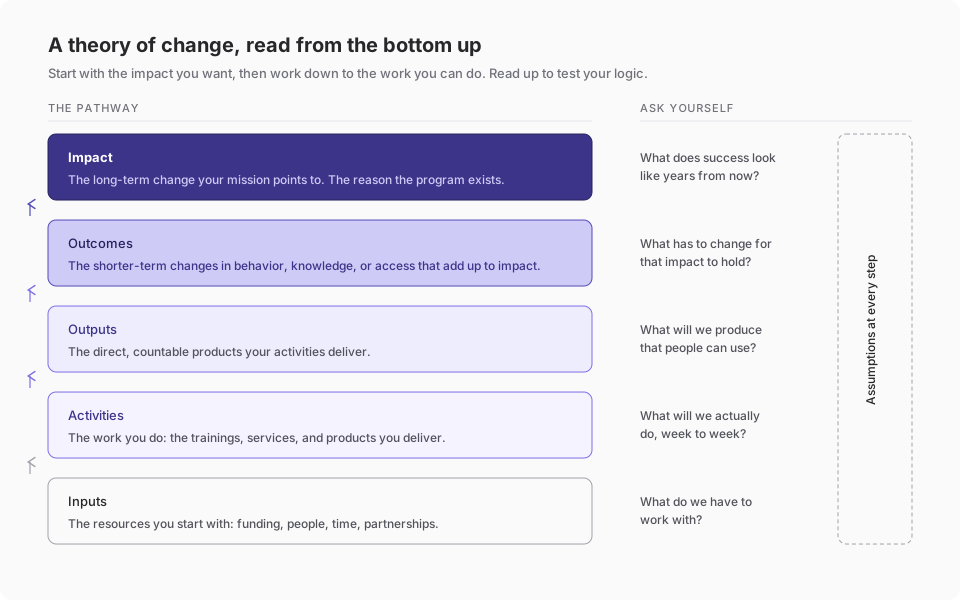
- Name the impact. What does success look like years from now? Write the long-term change your mission points to.
- Map the outcomes. What has to change for that impact to hold? These are the shifts in behavior, knowledge, or access that add up to your goal.
- Define the outputs. What will you produce that people can use? The countable products of your work.
- List the activities. What will you actually do, week to week, to deliver those outputs?
- Account for inputs. What resources do you have to work with?
- Surface the assumptions. For each arrow in the pathway, ask what has to be true for one step to lead to the next. These assumptions are the most valuable part of the exercise, because they are where a theory of change can break, and where an evaluation should look first.
Keep it to a single page. A one-page pathway everyone believes in beats a detailed diagram that lives in a proposal and never gets opened again.
From the field
A livelihoods team we supported kept reporting strong output numbers while their funder kept asking about impact. When we mapped their theory of change together, the gap was obvious: they had never defined the outcome between "farmers trained" and "household income rises." Naming that missing link, and one assumption about market access behind it, reshaped both their indicators and their next season's activities.
Common Mistakes to Avoid
Across the theories of change we have helped build and untangle, the same four problems recur:
- Too complex. A pathway with forty boxes and crossing arrows is not more rigorous, it becomes unusable. Complexity makes it more difficult to convey or comprehend.
- Not testable. Every outcome should be measurable enough that you could be surprised.
- Disconnected from M&E. The most common failure of all. A theory of change built for a proposal and then abandoned, while the M&E system tracks a separate set of indicators nobody traced back to it.
- Treated as a static diagram. A theory of change is a living hypothesis. If it never gets revisited as you learn more about your context, it stops being useful.
A recent IDS paper on misuses of theories of change highlights how common it is for organizations to reduce a ToC to a linear flowchart that satisfies a donor requirement without explaining how change happens. When assumptions go unnamed and the pathway never gets tested, the theory of change becomes the compliance artifact it was meant to replace.
Connecting Your Theory of Change to Your M&E System
Your outcome statements become your outcome indicators. Your assumptions become the questions your evaluations investigate. Your pathway becomes the structure your reporting follows. When these line up, M&E becomes a feedback loop that improves the program rather than just upward reporting.
Our guide to designing the right M&E system for your NGO covers how to choose indicators your field staff can realistically collect, and the M&E framework guide shows how the theory of change anchors the five components of a working framework. For evaluation-specific guidance, BetterEvaluation is a strong reference.
Getting Started
If you are building a theory of change from scratch, resist the urge to fill in a template first. Get your team in a room and answer one question: what change are we trying to make, and why do we believe our work will make it? Sketch the pathway backwards from there, name the assumptions, and only then formalize it for your donor.
At Hikaya, we help NGOs and nonprofits worldwide turn a theory of change from a proposal artifact into a working tool, one that connects your mission to indicators your team can actually track.
If your logic model and your M&E data have drifted apart, or you are staring at a blank template before a proposal deadline, a clear pathway is the right place to start. Start a conversation with us, or see how we approach discovery and design in our work.